Skip to content

The global flexible printed circuit board market was valued at USD 27.12 billion in 2025. Analysts expect it to reach USD 88.3 billion by 2035, representing a CAGR of 12.52% from 2026 to 2035.
Five years ago, engineers considered flexible circuitry a specialist alternative to standard rigid boards. Designers used it mainly where space was limited. Clearly, that positioning has shifted.
Smartphones, laptops, tablets and wearables remain the most visible drivers of that growth. However, they are no longer the whole story. Automotive electrification, 5G infrastructure and medical device miniaturisation pull original equipment manufacturers (OEMs) towards flexible circuitry. Consequently, companies choose flex for products that previously used rigid boards exclusively.
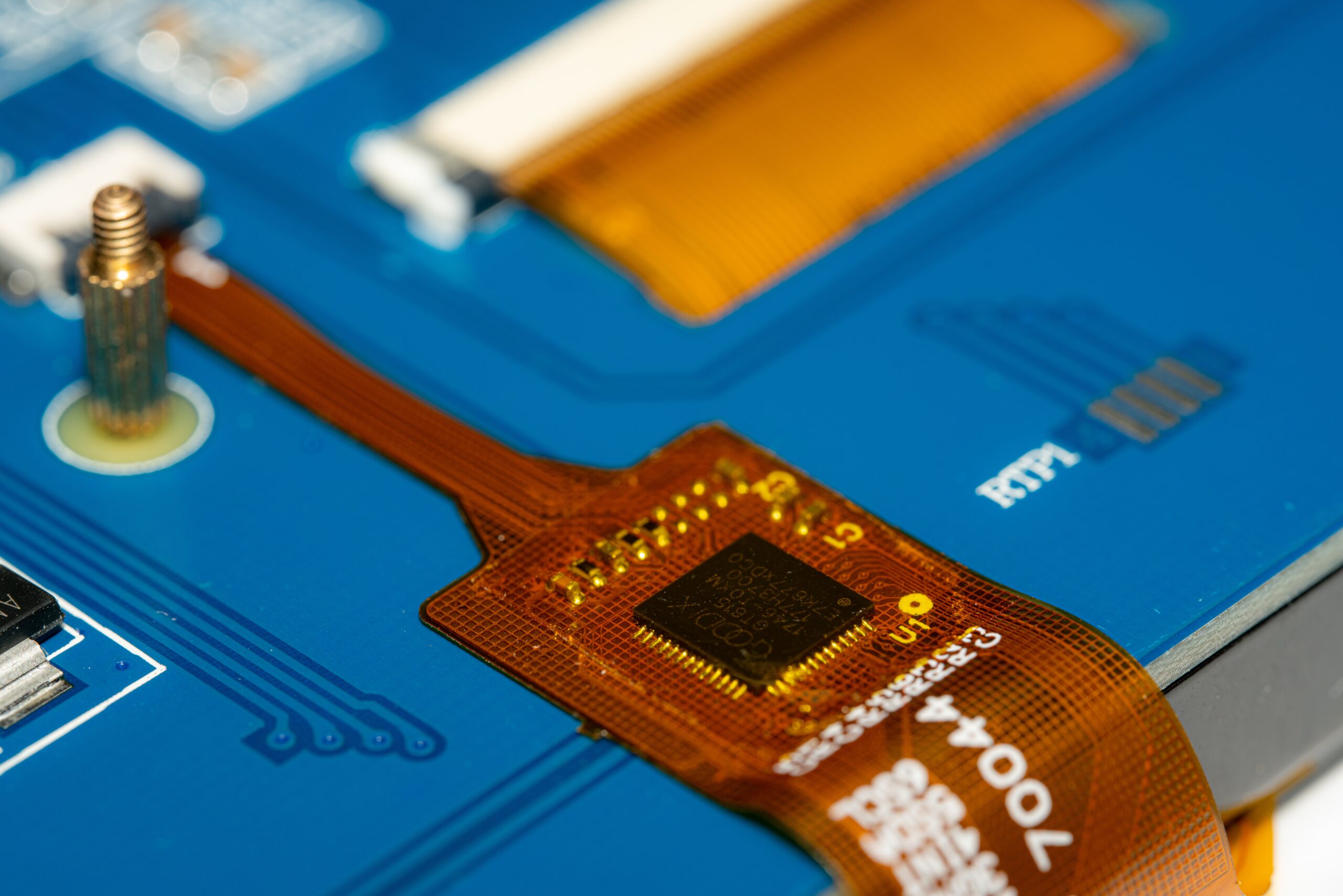
A flexible printed circuit board appears in automotive instrument clusters, ventilators and defibrillators. Furthermore, engineers integrate them into implantable devices such as pacemakers and cochlear implants. In these applications, the circuit must survive inside the human body.
When evaluating board technology for a new product, deciding between rigid or flexible PCBs is crucial. This choice sits alongside questions about protection, testability and partner capabilities. Thus, selecting the right team ensures delivery of your finished printed circuit board assembly at scale.
What a flexible printed circuit board changes
The headline benefit is bend radius.
A flexible printed circuit board fits into unique enclosure designs. Technicians can fold, roll, or wrap it into shapes a rigid board cannot occupy. Consequently, this removes separate boards joined by cable assemblies. As a result, it eliminates a major category of failure points. Every connector and cable joint creates risks of contact resistance, vibration fatigue, or moisture ingress over the product lifecycle.
In practice, engineers must design this benefit deliberately rather than assuming it.
IPC-2223 governs flexible and rigid-flex board design. This industry standard sets minimum bend radius ratios based on layer count. Additionally, it accounts for whether the bend is static or dynamic during operation.
A single-layer flex circuit in a dynamic application needs a specific bend radius. Typically, it requires at least ten to twenty times the material thickness. Tighter radii increase stress on copper traces and shorten circuit lifespan. Therefore, getting this wrong causes many flex projects to fail prototype testing. You should raise bend requirements with your electronics manufacturer before layout begins.
Reducing the number of separate connectors reduces overall part count. For this reason, flex circuits are popular in sensors and compact industrial devices. Where a product needs rigid and flexible sections, rigid-flex construction combines both on one board. Thus, it removes connectors between separate rigid and flex assemblies entirely.
Durability and environmental resistance
Engineers prefer flexible circuitry in demanding sectors because it lasts longer in the field. With fewer connectors, flex circuits absorb vibration effectively. As a result, components experience less stress on solder joints.
Dynamic flex circuits often use rolled annealed copper. In contrast, rigid boards rely on electro-deposited copper. Properly designed circuits achieve over 200,000 bending cycles with the right bend radius. Moreover, rolled annealed copper’s elongated grain structure provides superior fatigue resistance during repeated flexing.
Flex circuits perform exceptionally well across wide temperature ranges. Furthermore, they resist corrosion and moisture better than unprotected rigid boards. For this reason, manufacturers use them in automotive, marine and outdoor industrial equipment.
Some circuit sections require extra strength around connectors or heavy components. In these cases, workers bond a stiffener to the underside. Consequently, this restores local strength without affecting the overall flexibility. This approach represents standard practice for off-road vehicles and construction equipment.
Where flexible circuitry saves money, and where it doesn’t
A flexible printed circuit board costs more to manufacture than a rigid board on a unit basis. Raw materials are more expensive. In addition, lamination presses, etch processes and handling equipment require specialised machinery.
However, financial savings appear later during assembly. Using fewer cables and connectors reduces manual labor during printed circuit board assembly. Moreover, it minimizes component sourcing risks. For products with high connector counts, these savings fully offset higher bare board costs.
Furthermore, field maintenance costs decrease significantly. Fewer connectors mean fewer potential failure points in the field. This advantage is vital for subsea sensors or oil infrastructure where service calls cost money.
Conversely, if a product has a low connector count, the financial case weakens. Similarly, applications without bending requirements rarely justify the extra expenditure.
Protecting a flexible circuit: conformal coating, potting and encapsulation
Flexible circuits require protection from moisture, dust, chemicals and thermal cycling. However, protection choices must preserve flexibility.
Conformal coating serves as an ideal solution. Thin coatings like silicone or flexible acrylic add minimal mass. Therefore, the material moves with the substrate to protect against humidity without restricting bend zones. Furthermore, automated dispensing systems deliver consistent thickness control across the circuit compared to manual methods.
Engineers also apply potting and encapsulation to flex assemblies. However, technicians restrict these materials to rigid sections like connector interfaces. As a result, critical dynamic bend areas remain unaffected.
If your product needs environmental sealing and bending in the same area, redesign the layout. Applying a stronger compound will not solve underlying mechanical conflicts.
Thus, specify protection methods alongside board layout early in the project. Consequently, discuss conformal coating and potting with your PCB assembly services partner before finalising designs.
Choosing the right PCB: questions to answer before you specify a board
Before specifying flex, rigid or rigid-flex PCBs, you should consider:
A good electronics manufacturer works through these questions with you. These decisions affect manufacturability and reliability more than initial bill of materials costs. Therefore, if your current PCB assembly services partner avoids these topics, find out why.
EC Electronics: your partner for flexible and rigid printed circuit board assembly
EC Electronics possesses over 40 years of manufacturing experience. We support OEMs across automotive, medical, industrial, IoT and capital equipment sectors. Our sites in the UK, Netherlands and Romania operate under unified quality systems.
Our team collaborates with your engineers from the design stage. We apply design-for-manufacturability (DFM) support to flex, rigid and rigid-flex PCB layouts before volume production.
Our printed circuit board assembly capabilities feature Yamaha SMD pick-and-place lines and high-flexibility Juki lines. Additionally, we utilize forced-air convection reflow and lead-free wave soldering. Automatic optical inspection and functional tests back all processes. For protective measures, we run an automated coating line (Mycronic MY50) in Romania alongside full encapsulation.
Regarding quality, we operate to IPC-A-610 Class 3 for PCB assemblies. Furthermore, we follow IPC/WHMA-A-620 Class 3 for wire harness work. Multi-site ISO 9001, ISO 14001, AS9100, and ATEX/IECEx certifications back our operations.
Whether evaluating flexible circuitry against rigid alternatives or needing assembly services, our engineers offer full support. Consequently, we help you make informed decisions before tooling starts.
Not sure whether your next product needs flex, rigid or rigid-flex PCBs? Speak to our team and we’ll help you work through the trade-offs before you commit to a design.