Skip to content

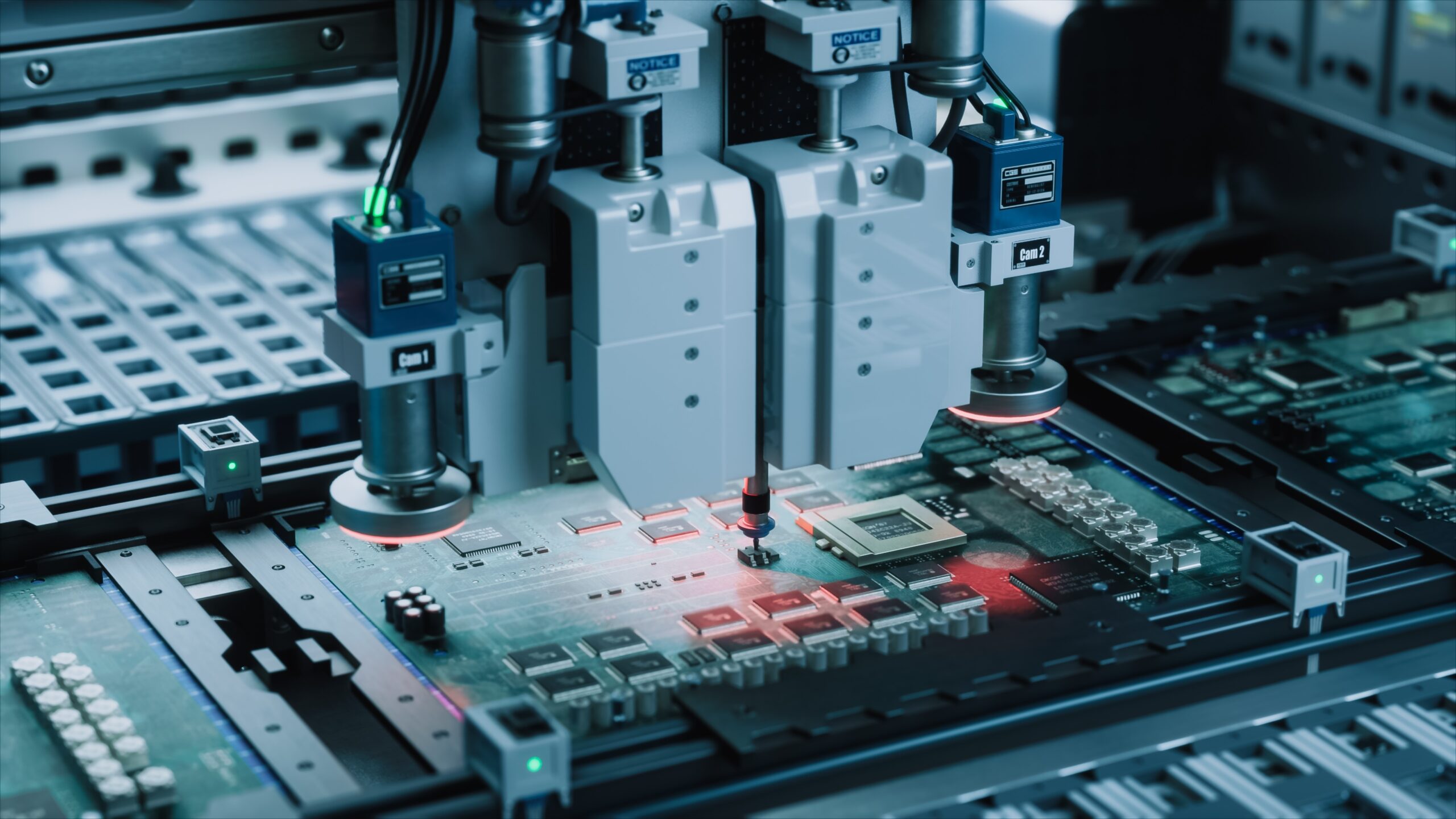
As well as sound electrical design, every finished product also needs accurately made mechanical parts to hold, protect, connect and support its electronic components.
A small dimensional problem can prevent an enclosure from closing correctly, misalign a connector or make final assembly more difficult. Material choice also affects weight, strength, heat management, electrical behaviour and resistance to the intended operating environment.
Machining gives OEMs a flexible way to produce precise custom parts from a wide range of metals and engineering plastics. It can support early prototypes, repeat production and complete product integration.
When machining is coordinated with electronic manufacturing services, mechanical and electrical requirements can be considered together rather than treated as separate projects.
What are machined electronic components?
Machined electronic components are parts made by removing material from a solid workpiece until the required shape and dimensions are achieved. This makes machining a subtractive process, unlike additive manufacturing, where a part is built up layer by layer.
Computer numerical control (CNC) allows machine tools to follow programmed instructions. Common processes include:
- Milling: a rotating cutting tool removes material to create features such as slots, pockets and flat or contoured surfaces.
- Turning: the workpiece rotates while a cutting tool shapes it, making the process suitable for cylindrical parts, such as shafts, pins and bushings.
- Drilling: a rotating tool creates holes for fasteners, connectors and mounting points.
- Grinding: an abrasive wheel removes small amounts of material to produce accurate dimensions or a fine surface finish.
One well-known example is Apple’s unibody MacBook enclosure. Apple introduced a design machined from a single block of aluminium, replacing an enclosure traditionally made from several separate parts with one main structure.
At a smaller scale, machining can produce housings, contacts, connector parts and other electronic components. The right process depends on the material, geometry, tolerance, surface finish and production quantity required.
Precision, repeatability and reliable assembly
One of the main benefits of machining is control. A CNC machine follows a defined program, helping a manufacturer reproduce the same geometry across a batch. However, accuracy still depends on suitable equipment, tooling, fixturing, process control and inspection.
For electronic components that must fit into a larger product, this control can improve:
- Alignment between connectors and enclosure openings.
- The position of mounting holes and fastening points.
- The fit between covers, panels and internal frames.
- Contact between heat-generating devices and thermal-management parts.
- Interchangeability when parts need to be replaced.
Good dimensional control can make assembly more straightforward because technicians should not need to adjust every part by hand. It can also reduce the risk of delays caused by components that do not fit the approved design.
This does not mean every dimension needs the tightest possible tolerance. Unnecessarily demanding tolerances can increase machining time, inspection requirements and cost. The drawing should therefore distinguish between critical features and dimensions where a wider tolerance will not affect fit, function or safety.
For an OEM, the goal is to achieve the right level of precision for reliable production and product performance.
Design flexibility from prototype to production
Machining does not normally require a dedicated mould or die. This can make it a practical option for one-off parts, early prototypes and low-to-medium production quantities, particularly when a design may still change.
Engineers can use a prototype to check:
- Whether the enclosure fits the internal layout.
- Whether ports, controls and displays are accessible.
- Whether mounting features line up correctly.
- Whether the chosen material provides sufficient strength.
- Whether technicians can assemble and service the product efficiently.
Because the part is created from digital design data, many changes can be introduced by revising the model, drawing and machining program. More significant changes may still require different stock, tools, fixtures or process planning, so it is important to review the effect before approving a revision.
Machining can also create a functional prototype in the intended production material. This may give an OEM more useful information than a visual model where strength, heat transfer, electrical conductivity or chemical resistance needs to be assessed.
Once the design is stable, the same controlled process can support repeat batches. At very high volumes, however, die casting, moulding or another production method may offer a lower unit cost. The right choice depends on total lifecycle cost, not machining cost alone.
Choosing materials and finishes
Machining can be applied to many metals and engineering plastics. The best choice depends on what the part must do and the conditions it will face.
Common options include:
- Aluminium: relatively lightweight, machinable and useful where heat dissipation matters.
- Stainless steel: suitable where strength, wear resistance or corrosion resistance is important.
- Copper: offers high electrical and thermal conductivity, although it can be more challenging to machine than many aluminium grades.
- Brass: often used for fittings, terminals and connector parts because it combines machinability with useful electrical and corrosion properties.
- Titanium: combines strength, low density relative to steels and corrosion resistance, but generally costs more to buy and machine.
- Engineering plastics: can provide low weight, electrical insulation, chemical resistance or low friction, depending on the polymer selected.
The material used for electronic components must also be compatible with neighbouring parts and the intended environment. Engineers may need to consider galvanic corrosion between different metals, operating temperature, cleaning chemicals, flammability requirements and regulatory restrictions.
Finishing can add further properties or improve appearance. Options include anodising, plating, passivation, painting, powder coating and bead blasting. Deburring is also important because sharp edges or loose burrs can affect handling, fit and cleanliness.
Machining, die casting or 3D printing?
Machining is not automatically the best process for every part. OEMs should compare it with realistic alternatives before committing to production.
| Consideration | CNC machining | Die casting | 3D printing |
| Basic method | Removes material from solid stock | Forces molten metal into a die | Builds a part layer by layer |
| Upfront tooling | No dedicated mould or die is normally required | Requires dedicated tooling | No dedicated mould or die is normally required |
| Design changes | Often made through revised design data and programming | May require tooling changes | Usually made through the digital model |
| Suitable quantities | Commonly used for prototypes and low-to-medium quantities | Often economical for stable, high-volume metal parts | Commonly used for prototypes and selected production applications |
| Material options | Wide range of machinable metals and plastics | Limited to suitable casting alloys | Determined by the printing process and machine |
| Main trade-off | Material is removed as chips and cycle time can be significant | Higher tooling cost and lead time | Finish, accuracy, build rate and material properties vary by process |
The decision should consider geometry, tolerances, finish, material properties, testing needs, anticipated quantities and the likelihood of design changes. A hybrid approach may also work; for example, a near-net-shape casting may be machined afterwards where critical faces or holes require tighter control.
Machining is particularly useful when an OEM needs production-grade materials, controlled interfaces and design freedom without investing in dedicated mould tooling. Die casting can become attractive when demand is high and the design is stable, while 3D printing may be valuable for rapid design evaluation or geometries that are difficult to manufacture another way.
Applications across demanding industries
Machined parts appear in many sectors because the process can be adapted to different materials, quantities and performance requirements.
- Industrial products: machining can produce prototypes, control enclosures, equipment panels, fixtures and replacement parts. It is useful when a product requires customised interfaces or changes between versions.
- Medical technology: potential applications include equipment housings, instrument parts and components for monitoring or diagnostic systems. Medical-device requirements depend on the product and market, so material selection, validation, cleanliness and traceability must be assessed for the specific application.
- Aerospace and defence: machining is used for brackets, housings, bushes and other precision parts. Applicable quality, material and documentation requirements vary according to the programme and the part’s function.
- Electronic products: machined heat sinks, connector parts, panels and enclosures can support protection, alignment and thermal management.
For OEMs, the common requirement is controlled integration. A part may be dimensionally correct on its own but still create problems if it has not been designed around the rest of the system. This makes coordinated electronics box-build integration particularly valuable for complex products.
Electronic manufacturing services can bring procurement, assembly, protective processing and testing into the same product-realisation workflow, helping teams consider the finished unit rather than a collection of unrelated parts.
Choosing electronic manufacturing services for complete products
A machined part delivers the most value when it works correctly within the complete product. That means considering the enclosure, printed circuit board assembly, wiring, connectors, protective processes and test requirements as one connected manufacturing project.
EC Electronics supports OEMs from design-for-manufacture assistance, component sourcing and material traceability through to mechanical integration, electronics box build and functional testing. Our teams can integrate machined enclosures, panels, brackets and other mechanical parts with the electrical assemblies they support, helping to identify problems with fit, access, cable routing and assembly before the finished product reaches repeat production.
By coordinating these stages through one electronic manufacturing services partner, OEMs can reduce the number of supplier interfaces and maintain clearer oversight of the complete product.
From simple enclosure builds to complex and multi-stage product integration to initial prototypes and volume manufacturing, EC Electronics brings precision mechanical parts and electrical assemblies together in a fully integrated and tested product. Speak to our team today to discuss your project.