Skip to content

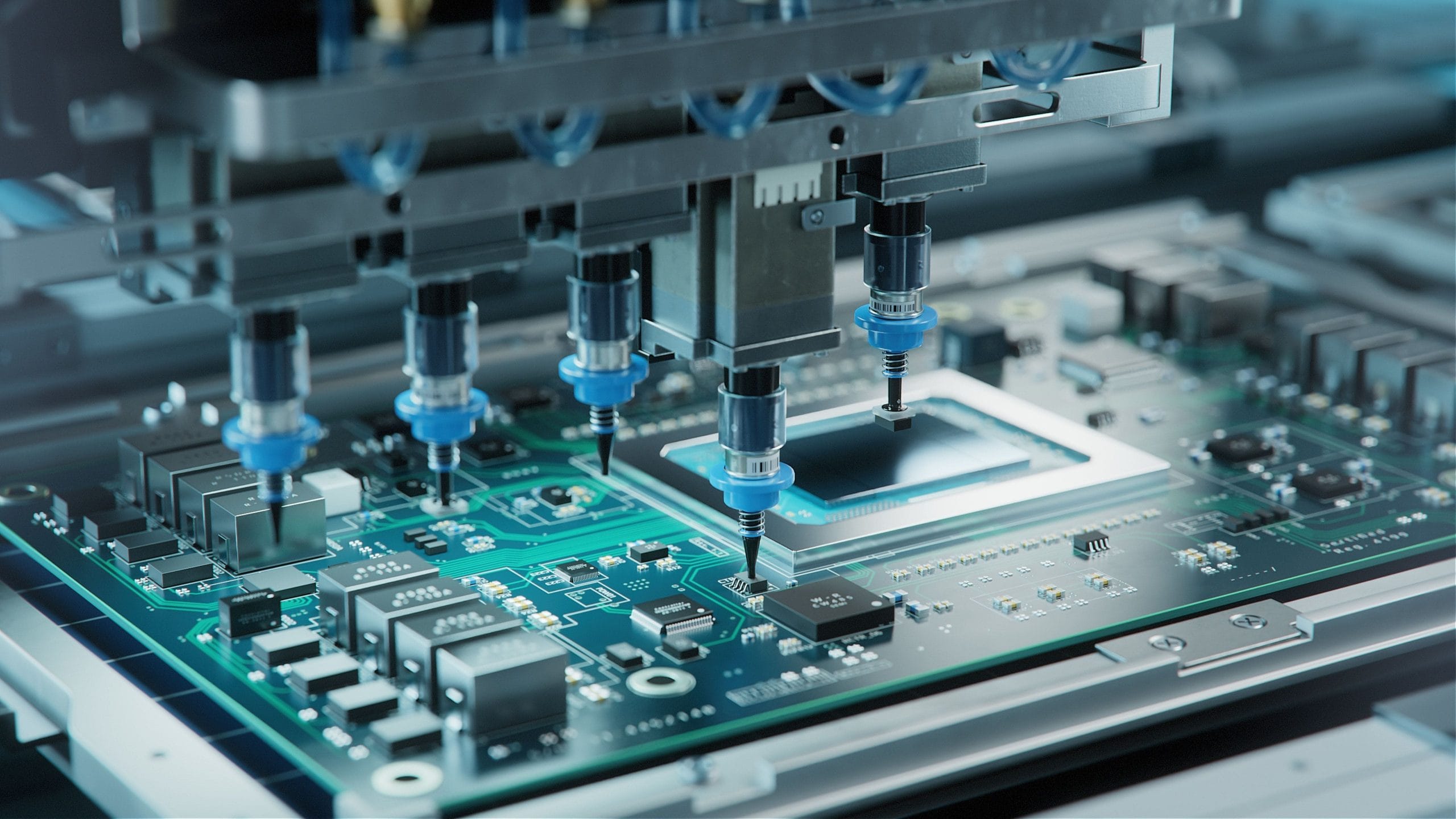
Miniaturisation hasn’t just made products sleeker — it has changed how we design, validate, manufacture and service electronics. Printed circuit boards (PCBs) have evolved from simple component carriers into engineered interconnect platforms, driven by advanced materials, equipment and techniques.
For OEMs, the challenge is no longer whether printed circuit boards can be made small enough.
It’s how to select the right board technology, stack-up and PCB assembly approach so that your product can scale, survive its environment and remain manufacturable when supply chains or component packages change.
Below is a practical look at where boards came from, where they are today, the machinery that enables modern builds and how to choose the best option for your application.
A quick history: from point-to-point wiring to modern PCB technology
Early electronic products relied on point-to-point wiring: metal strips, rods and hand wiring between terminals. It worked — until circuits grew in component count and complexity, and physical wiring became too bulky, inconsistent and slow to build.
A major milestone came in 1925, when inventor Charles Ducas patented an approach often described as ‘printed wires’, using electroplating concepts to form conductive patterns on an insulating surface. Later, Paul Eisler advanced the concept by developing etched copper foil circuitry on an insulating substrate — a step that helped move the technology from lab concept toward industrial use.
Post-war manufacturing made the approach practical at scale.
By the late 1940s, processes emerged that enabled more consistent production of boards, and through the 1950s to 1970s, the industry progressed rapidly: double-sided construction, plated through holes, multilayer boards and then the shift toward surface-mount components as packaging and assembly automation matured.
The key theme across the entire timeline is density. As products demanded more functions in less volume, the interconnect platform had to evolve — and printed circuit boards evolved with it.
Where boards are now: common types of printed circuit boards
Today, design teams can choose from a broad menu of structures and materials. The best option depends on packaging density, mechanical constraints, operating environment and your cost/volume curve.
Rigid PCBs (single, double and multilayer)
Rigid FR-4 builds are still the default choice for many products due to cost-effectiveness and a mature supply chain. Multilayer rigid designs support high routing density, controlled impedance and good mechanical stability.
HDI (High-Density Interconnect)
HDI typically uses micro-vias, finer lines/spaces and higher layer counts to route tight-pitch devices. If you’re using fine-pitch ball grid arrays (BGAs), dense power distribution or want smaller form factors, HDI can reduce board area and sometimes improve electrical performance (shorter interconnects), but it raises design and printed circuit board production complexity.
Flexible and rigid-flex PCBs
Flexible circuits and rigid-flex boards are now mainstream in space-constrained products and devices with repeated motion, folding or tight packaging. For example, in medical devices, flexible printed circuit boards are commonly used to fit electronics into compact enclosures, route signals through hinges or conform to curved internal geometries.
From a manufacturing standpoint, flex and rigid-flex boards introduce new considerations (stiffeners, bend radius rules, coverlays, handling/fixturing), and they often require earlier engagement between design and manufacturing to prevent yield loss during PCB assembly.
Thermal substrates and metal-core PCBs
If your design is power dense (LEDs, power conversion, motor drives), thermal management can become the dominant board requirement. Metal-core or thermally enhanced substrates are chosen to move heat efficiently out of hot components.
Speciality materials (RF/microwave, high-reliability, harsh environments)
If you need controlled dielectric properties for radio frequency performance, high-temperature resilience, or chemical resistance, material selection becomes a primary design lever. The more specialised the materials, the more important it is to validate availability and process capability across printed circuit board manufacturers early, especially before you lock your stack-up.
The processes behind modern printed circuit board production
Miniaturisation doesn’t happen by design intent alone — it happens because manufacturing equipment can repeatedly place, solder, inspect and test tiny components at speed.
SMT: the core of high-density assembly
Surface-mount technology (SMT) is the foundation of compact electronics. In a typical SMT flow, solder paste is printed through a stencil, components are placed by automated pick-and-place, and joints are formed in a controlled reflow oven.
To maintain process stability, many operations also use inspection stages, such as solder paste inspection (SPI) and automated optical inspection (AOI). AOI is commonly used to detect polarity errors, tombstoning, insufficient solder and alignment issues before boards move downstream.
THT: still essential for strength, power and connectivity
Through-hole technology (THT) remains the right tool for components that need mechanical robustness or higher current handling — think connectors, transformers, large capacitors, heatsinks and shields.
For THT soldering, many factories use lead-free wave soldering for volume throughput, alongside selective soldering when only certain through-hole joints need soldering on mixed-technology builds. This matters because more products are hybrid by necessity: dense SMT on one side, rugged THT where mechanical loads demand it.
Electrical test and protection processes
As designs become denser and printed circuit boards smaller, testing becomes more complex. In-circuit test (ICT) and functional test help catch assembly escapes and process drift; some providers support ATE/ICT to improve coverage for complex builds.
For harsh environments, many OEMs specify conformal coating, potting or encapsulation to protect assemblies from moisture, dust, vibration and corrosion — but these protection steps should be aligned to your test plan (what must be tested before coating versus after).
All of the above is why the best outcomes usually come from treating PCB assembly and test as part of the design process — not as an afterthought once the layout is finalised.
Choosing the right PCB assembly for your application
When selecting a board technology, you need to weigh size, reliability, unit economics and supply continuity. Here are the considerations that most often affect cost, yield and time-to-scale.
1. Mechanical constraints and interconnect strategy
2. Environment and protection requirements
3. Thermal performance and power density
4. Manufacturability and testability
Many avoidable issues show up at the manufacturing interface:
Engaging electronics manufacturing services early often reduces re-spins and speeds up NPI because the assembly process, inspection points and test requirements are mapped to the design before it is frozen.
5. Supply chain resilience and lifecycle risk
6. Volume profile and total cost (not just board price)
It’s easy to compare only the board fabrication quote. But real unit economics reflect yield, rework rate, test time and how smoothly you can scale:
This is where printed circuit board production and assembly choices intersect — and why experienced electronics manufacturing services partners tend to ask as many questions about test strategy and environment as they do about layer count.
Partnering with advanced printed circuit board manufacturers
EC Electronics provides end-to-end electronics manufacturing services, including PCB assembly for OEMs that need reliable, repeatable build quality from prototype to production.
With 40 years’ experience as printed circuit board manufacturers, EC supports everything from basic assemblies to more complex requirements, including flexible circuits, thermal substrates and PCBs with blind and buried vias, backed by an established component sourcing network and controlled storage for moisture-sensitive parts.
Our PCB manufacturing capability spans surface-mount and plated through-hole assembly across our UK and Romania facilities, using high-speed processes and state-of-the-art convection reflow and wave soldering equipment.
Key capabilities include:
Our SMT lines can place BGA parts and fine-pitch devices, and our through-hole processes support assemblies used in critical applications, such as transformers, heatsinks, RF shields and connectors.
Quality is built into the process, with trained operators assembling complex boards to IPC-A-610 Class 3 and inspection using 3D AOI. Our quality management system is also ATEX certified, supporting intrinsic safety requirements for potentially explosive atmospheres.
To discuss your next PCB project, speak to our team today to talk through your requirements.